



Full-Grain Leather Dog Slip Lead with Brass Hardware


Full-Grain Leather Dog Slip Lead with Brass Hardware
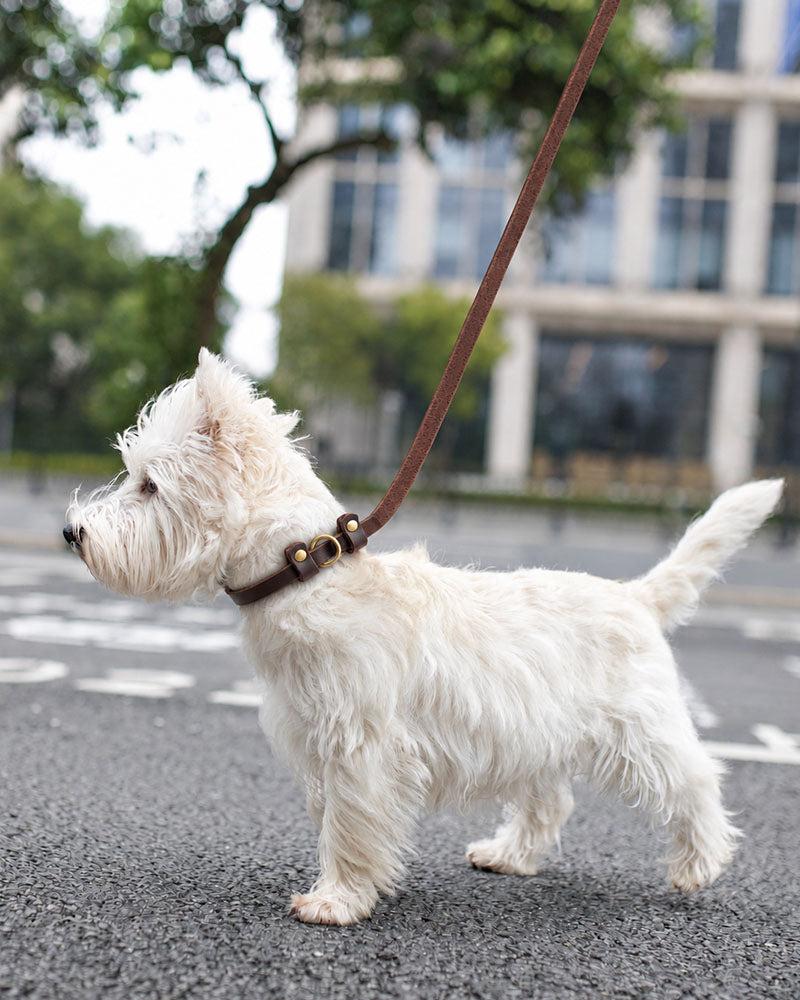
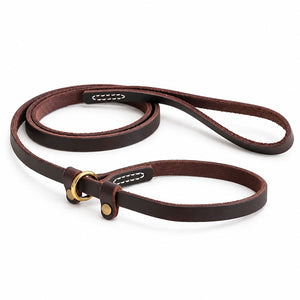
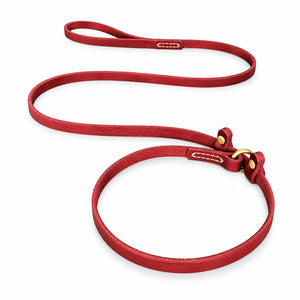
Crafted from full-grain leather, this slip lead combines a collar and leash into one streamlined design for quick handling without a separate collar attachment—classic leather control with a clean, understated profile.
Highlights
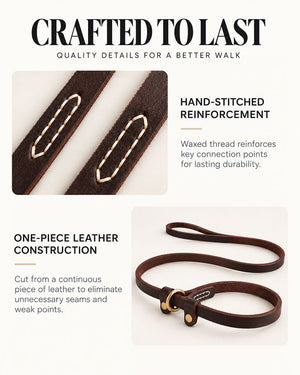
- One-piece slip design: the leather forms the slip loop and continues into the lead for a simple, functional connection between dog and handler.
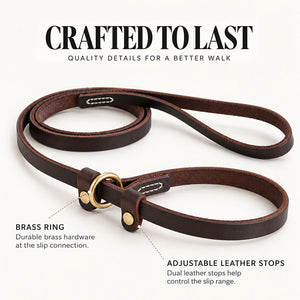
- A brass ring lets the loop move naturally, so the lead slips over the head for walks, training sessions, and quick on-and-off handling.
- Dual adjustable leather stoppers help manage the working range of the slip loop for a more deliberate fit while keeping the traditional slip-lead simplicity.
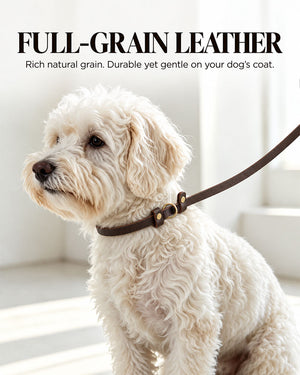
- Full-grain leather provides natural texture, a substantial hand feel, and classic appearance that develops character with use.
- Brass hardware complements dark leather with a timeless finish; reinforced stitching at key points supports the construction without cluttering the profile.
- Flat leather construction feels substantial in hand while staying cleaner and more understated than bulky multi-piece walking setups.
- Suited to medium and large dogs as well as appropriately sized smaller breeds—for everyday walks, obedience work, and controlled handling when a separate clip-on leash is unnecessary.
Fit & use note:
Use under supervision only. Avoid continuous tension on the neck, and do not use for unattended tethering. Correct fit and calm handling matter with any slip-style lead. For strong pullers or everyday walking load, prefer a fitted harness with a standard leash.
Related: Slip vs Buckle · Leash Guide · Brass vs Stainless
| Color |
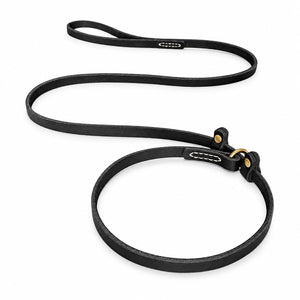
Brown, Black, Red |
|---|---|
| Width |
0.5 in (1.3 cm), 0.6 in (1.5 cm) |
| Length |
4 ft (1.2 m), 5 ft (1.5 m), 6 ft (1.8 m) |
| Material |
Brass, Full Grain Leather |
| Care Instructions |
• Air dry naturally and keep away from prolonged direct sunlight. |
How to Use a Leather Slip Lead
A slip lead is a one-piece collar-and-leash design. The leather loop tightens when the line takes tension and should loosen when the leash goes slack. Choosing the right width and length, setting the leather stopper(s), and using calm handling are important for comfortable, controlled use.
Hardware finish and the number of stoppers can vary by product—check the product description for the exact options on the lead you ordered.
1. Choose Width and Length Before You Buy
Use the product options and the Size Guide as a starting point:
-
Narrower width (about 0.5 in / 1.3 cm)
Often better for smaller dogs and lighter handling.
-
Wider option (about 0.6 in / 1.5 cm)
A more substantial feel for many medium dogs and calm large dogs.
-
Shorter lengths
Closer control for training, doors, and busy sidewalks.
-
Longer lengths
More room on calmer routes (still not a long-line).
If your dog pulls hard or is reactive, do not rely on a slip lead as the main everyday walking tool. Prefer a fitted walking harness with a standard leash. See Harness vs Collar and leash length basics.
2. Confirm the Loop Can Pass Over the Head
Before first use (and when choosing size), measure the widest part of the head—typically around the ears and under the jaw.
-
Form a loose loop
Form the slip lead into a loose loop through the metal ring.
-
Check head pass
Check that the loop can pass comfortably over the widest part of the head without forcing.
-
Check neck settle and release
On the neck, the loop should settle high enough to stay secure, then loosen clearly when the leash is slack.
If the loop cannot pass over the head, the setup is too small. If it slides off easily when slack, reassess stopper position and handling—do not solve escape risk by leaving the loop permanently tight.
3. Putting It On
-
Open the loop
Hold the metal ring and form a loose, open loop.
-
Guide over the head
Gently guide the loop over your dog’s head and settle it on the neck.
-
Check free slide
Confirm the leather slides freely through the ring.
-
Test tighten and release
Apply light leash tension briefly, then release—the loop should tighten smoothly and loosen again when the line goes slack.
4. Adjust the Leather Stopper(s)
Your lead may have one or two sliding leather stoppers. Use the ones on your lead to set a safer working range for the slip loop:
-
One stopper
Slide it to limit how far the ring can travel so the loop does not open too wide (risk of slipping off) or close in a way that feels uncontrolled. After adjusting, confirm the loop still loosens when the leash is slack.
-
Two stoppers
Use them together to define a working range around the ring—typically one limit toward “not too loose / less likely to slip off,” and one toward “not too tight.” The loop must still open enough to release pressure when the leash is slack.
After any adjustment, re-check: slack leash = loop loosens; light tension = loop closes smoothly. Never set stopper(s) so the neck stays tight for the whole walk.
5. During Use
-
Calm handling
Use calm, controlled leash handling. Avoid jerks and prolonged hard tension.
-
Tighten only under tension
The slip loop should tighten only when tension is applied and return toward a relaxed position when the leash is loose.
-
Keep the ring free
Keep the lead moving freely through the metal ring—do not let twisted leather or stuck stoppers hold the neck tight.
-
Shorten control without choking
For busy streets or strong distractions, shorten your effective control with hand position and shorter lead length—not by locking the neck closed with the stopper(s).
More context on slip-style gear vs everyday buckle collars: Slip vs Buckle. Hardware finishes (such as brass or stainless) are covered in Brass vs Stainless.
6. Safety Notes
Supervision only. Do not leave a slip lead on an unattended dog.
No tethering. Do not use for tie-outs, crate attachment, or fixing the dog to a stationary object.
Not a pull-training shortcut. Continuous neck pressure is not a substitute for harness fit and training.
Inspect regularly. Check leather, metal ring, stopper(s), and stitching. Stop using the lead if any part is cracked, seized, or unsafe.
Keep a separate buckle collar for ID tags when you are not using the slip lead.
After wet walks, wipe leather and metal hardware dry. Condition leather as needed.
What is a slip lead?
A slip lead is a one-piece collar-and-leash design. The leather loop slips over the head and tightens under leash tension, then should loosen when the line goes slack. See Slip vs Buckle for how slip-style gear differs from everyday buckle collars.
Should I use this for everyday walks instead of a harness?
Not for most pullers. Slip leads are for supervised handling and trained contexts. For everyday walking load, clip a standard leash to a fitted harness and keep a buckle collar for ID. See Harness vs Collar.
What do the dual leather stoppers do?
The two leather stoppers help set the working range of the slip loop so fit and movement feel more deliberate. Adjust them so the loop can loosen when the leash is slack—never leave continuous neck pressure.
Can I leave this on my dog or use it for tethering?
No. Use under direct supervision only. Do not leave a slip lead on an unattended dog, and do not use it for unattended tethering or tie-outs.
How do I care for the leather and brass?
Wipe clean, condition leather as needed, and avoid prolonged soaking. Wipe brass dry after wet walks. More in leather maintenance and Brass vs Stainless.
Where can I find sizing and shipping info?
Confirm the loop can pass over the head comfortably, then check working fit on the neck. Use the Size Guide. Policies: Shipping · Returns.